Saphira and Ashton relationship
A Werewolf Thing: A Rejected Mate Werewolf RomanceThe Saphira and Ashton relationship is the emotional and domestic bond between Saphira and Ashton, a partnership repeatedly tested by rejection, physical danger, pregnancy, and attacks on the pack. Its importance lies in the way protection functions both as devotion and as a source of conflict: Ashton shelters Saphira, worries over her safety, and ultimately searches for her with desperate determination, while Saphira continues to insist on her own strength and right to act. By the ending, their relationship has become a shared household and family rather than merely a threatened mate bond.
Origins and Early Vulnerability
The relationship is established against Saphira’s fear of being rejected by Ashton, her mate. That fear is not private for long: after Saphira is distressed, her twin brother Trevor recognizes that something is wrong because the twin bond allows them to sense one another’s emotional and physical pain. Saphira initially lies about being fine and avoids saying that her mate has rejected her, showing how precarious the relationship feels before Ashton becomes a dependable partner.
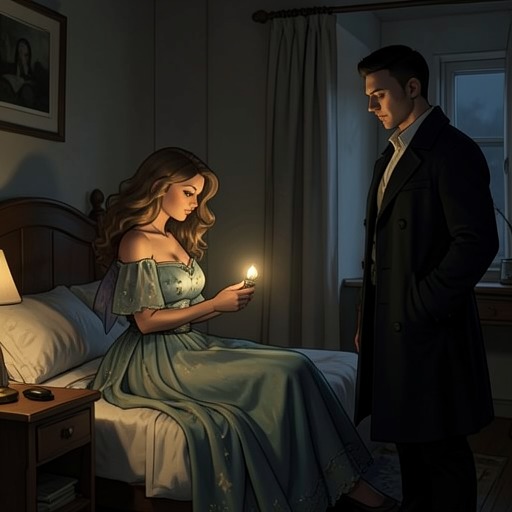
Ashton nevertheless becomes a source of immediate comfort when Saphira tells him what Trevor has done. He offers to let her stay with him for the night because she does not want to see Trevor, then wraps his arms around her, pulls the covers around them, and turns off the light. The scene presents intimacy as refuge: Ashton cannot erase the hurt caused by rejection, but he gives Saphira a place where she does not have to confront it alone.
Protection, Risk, and Care
The couple’s attachment is repeatedly expressed through attempts to protect one another. When an arrow strikes Saphira, a doctor reveals that it was coated in poison. Ashton’s immediate reaction is shock and alarm, underscoring that threats to Saphira become personal crises for him rather than distant pack matters. Later, when Saphira is pregnant, Ashton’s protective concern becomes more directive. Trevor warns that she cannot lead an army while pregnant, but Saphira rejects the implication that pregnancy makes her incapable of defending herself, arguing that her half-faery nature allows her to cast a protective charm.
This disagreement exposes a central tension in the relationship. Ashton’s care is sincere, yet protection can also become an effort to determine what Saphira may safely do. Saphira does not accept vulnerability as a complete definition of her condition. Her response preserves her agency, while Ashton’s concern reveals how strongly the possibility of losing her governs his conduct.
That fear becomes explicit when rogues invade the pack’s boundaries and abduct Saphira. Ashton strikes the table in frustration and declares that he does not care about the rogues’ broader threat because he must find her. When Simon argues that the situation should be considered carefully because war was precisely what they had tried to avoid, Ashton refuses restraint, insisting that the rogues have taken what is his. He identifies the abduction not only as an attack on the pack but as a violation of the relationship itself, and he resolves to find and kill those responsible.
Reunion and Restored Trust
The rescue and reunion change the emotional charge of the relationship from absence and panic to physical reassurance. When Ashton reaches Saphira, she moves toward him, throws herself into his arms, and he embraces her carefully around her stomach. Their exchange is simple but significant: Ashton says that he missed her, while Saphira points out that he was gone only a day. Ashton answers that he misses her whenever they are apart, making separation itself the measure of his attachment.
Their kiss confirms the reunion as more than a successful recovery from danger. Saphira concludes that Ashton has found her and that perhaps everything will be all right this time. The wording retains an awareness of earlier instability, but the moment also supplies a renewed promise: after abduction and fear, physical closeness becomes evidence that the relationship has survived another rupture.
The restoration is also verbal. Ashton apologizes for having been a jerk and explains that he does not want to lose Saphira. She answers that he will never lose her, and he responds by kissing her. His admission makes vulnerability possible where possessiveness and anger had previously dominated; Saphira’s reassurance converts that vulnerability into renewed mutual confidence.
Building a Shared Household
Pregnancy gives the relationship a practical future and changes the couple’s living arrangement. Ashton believes that they should have a house of their own, so they move out of the pack house and buy a two-story house. Saphira objects that it is far too large, but Ashton wants enough room for friends and family to stay overnight. The house therefore represents more than privacy: it is designed as an extension of their wider network of kinship and pack belonging.
The arrangement is adapted to Saphira’s pregnancy. Their bedroom and the nursery are placed on the first floor because she lacks the energy to climb the stairs repeatedly. This detail makes Ashton’s care concrete rather than abstract. The relationship is not only defined by declarations or rescues; it is also organized around Saphira’s changing physical needs and the preparation for their child.
Family Life and Lasting Significance
Years later, the relationship is shown as an established family life with their six-year-old daughter Crystal and their son Clayton. When Saphira suggests that Crystal’s future mate may be high-ranking and that she might become a Luna, Ashton objects from the doorway, refusing to accept the idea of Crystal being claimed by a mate so easily. His response adds a playful but recognizable continuation of his protective character: the same fear of losing someone he loves now appears in his attitude toward their daughter.
The domestic scene is filled with reciprocal affection. Ashton tells Saphira that he loves her and kisses her, while she returns the declaration. He then kisses Crystal and pinches Clayton’s cheek, saying that he loves all of them. The family’s affection is presented as shared rather than exclusive, extending the couple’s bond into a household in which children, tenderness, and ordinary physical gestures become signs of security.
The relationship’s ending is emphatically reassuring. After the earlier rejection, poisoning, pregnancy-related conflict, and abduction, the narrative closes on Saphira’s conviction that everything is okay and great. The Saphira and Ashton relationship thus follows a movement from threatened intimacy to durable attachment: its final form is not merely romantic survival, but a family structure in which danger has been answered by reunion, care, and mutual declarations of love.